

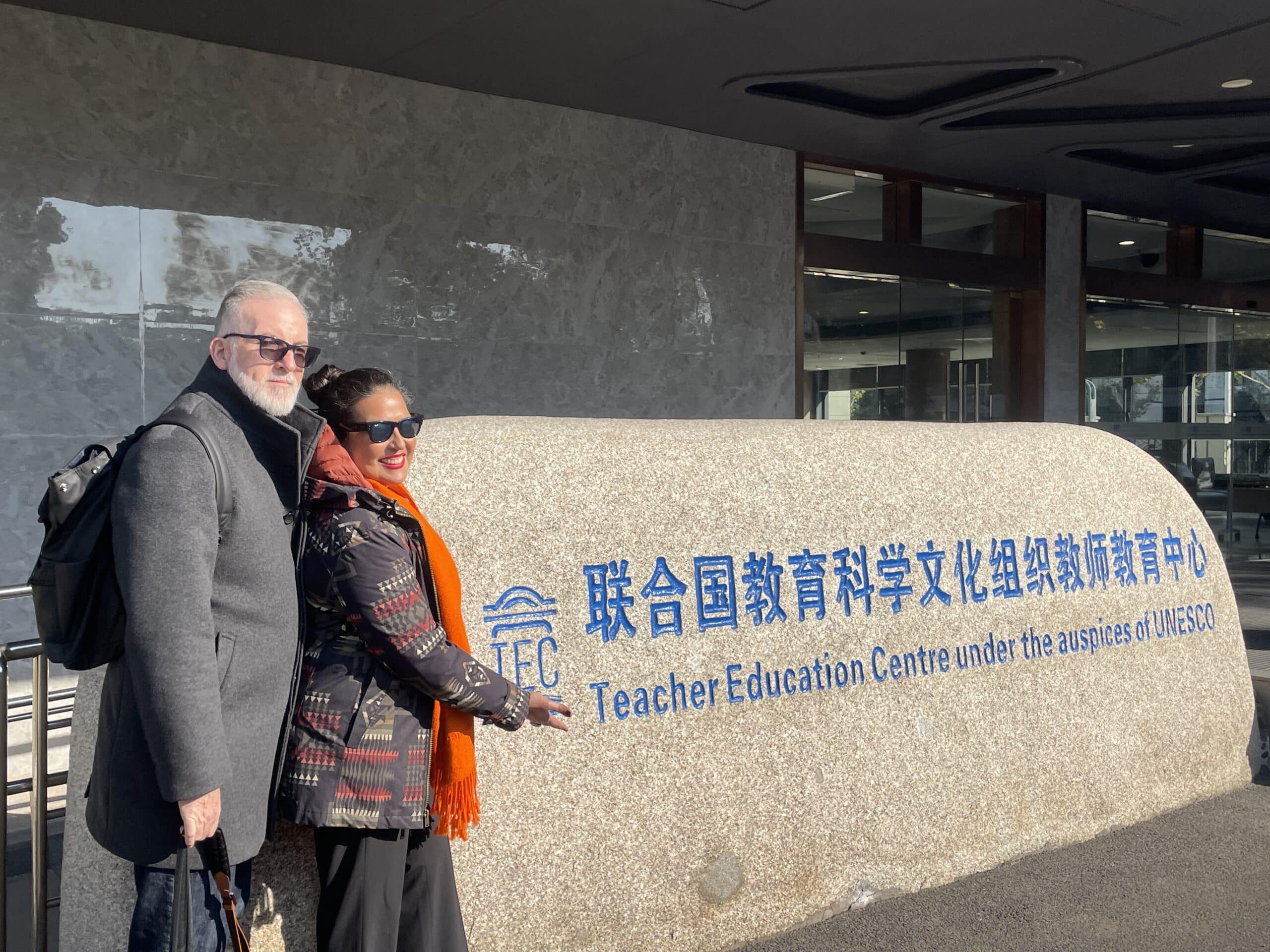
In December, five High Tech High educators boarded a plane bound for Shanghai. Nerves soon gave way to excitement. They were headed to China to co-create, sharpening their own learning and craft in the process. What unfolded over the next two weeks was an experience still rare for educators in the U.S. and around the world. It illustrated what happens when educators across cultures design, reflect, revise, and imagine together.
The cohort—Montse Kevan (High Tech High North County), Sabelle O’Connell (High Tech High Media Arts), Lexi Wiggins (High Tech High Mesa), Daniela Torres (High Tech Middle Mesa), and David Garcia (High Tech Middle Mesa)—had been invited to participate in a joint professional learning exchange hosted by the UNESCO Teacher Education Centre (TEC) at Shanghai Normal University.
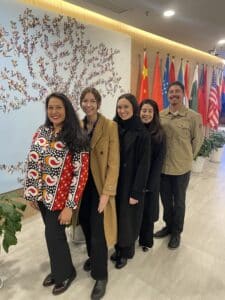
The invitation centered on learning from High Tech High teachers about how interdisciplinary, student-centered learning is designed and implemented in practice. But this was not a typical international training or study tour. It became a fully co-designed collaboration among High Tech High TK–12, the High Tech High Graduate School of Education (HTHGSE), and the UNESCO Teacher Education Centre.
“The whole experience was layers of collaboration,” said Nuvia Ruland, Director of Professional Learning at the HTH Graduate School of Education. “This was never about exporting a model. It was about building something together.”
UNESCO TEC funded the effort. The program also involved Shanghai Normal University, East China Normal University, Jing’an Public Schools, and other regional educators.
The two-week experience was co-coordinated by Ruland, and Prof. Xu JinJie of the UNESCO Teacher Education Centre. From the outset, they imagined something different from a traditional professional development program—an exchange rooted in lesson study, interdisciplinary design, and mutual learning.
The program reflected High Tech High’s core philosophy: make learning real, collaborative, and connected to the world.
The exchange opened with two “Leave to Learn” experiences—immersive field explorations designed to make the walls of school permeable to the world in which students are growing up. After visiting places like the Huangpu River and the historic city of Suzhou, HTH teachers and Jing’an District educators returned to the center to reflect on what they had seen, using the Kaleidoscope framework to ideate interdisciplinary projects rooted in lived experience.
Educators worked in cross‑cultural teams to design interdisciplinary lessons that would be implemented the following week as part of a lesson study. Each High Tech High teacher coached a group of three Shanghainese public school teachers through the design process.
Three lesson concepts were selected for deeper study: Two interdisciplinary STEM‑focused lessons and a third lesson on cats (māo) that blended history and biochemistry and showed extraordinary promise for student engagement
Before teaching the new lessons, the HTH teachers visited Jing’an schools to gain a baseline understanding of classroom culture and instructional practices. Then came the real test: implementation.
Chinese teachers facilitated the interdisciplinary lessons with middle and high school students while educators observed using a High Tech High–inspired observation tool. What followed mirrored the project‑based learning cycle HTH students know well—critique, reflection, and revision.
“There is no perfection in education,” Ruland noted. “What matters is how we learn from feedback and improve.”
Together, Jing’an teachers and HTH educators refined the lessons and re‑taught them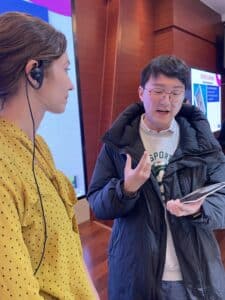 to new groups of students. The transformation was striking. Prof. Xu described the shift as learning becoming “fully embodied.” Students raised their hands to share lived experiences, worked in small groups to visualize their thinking, and moved around the classroom exchanging ideas.
What had once been a traditional classroom environment had become student‑centered, collaborative, and alive with inquiry.
The exchange left a lasting impression on educators on both sides of the Pacific. When the exchange ended, Prof. Xu found herself struggling to return to normal routines.
“I am just back to work now and already starting to miss your excellent teachers from HTH,” she wrote to High Tech High CEO Dr. Diana Cornejo-Sanchez. “It is difficult for me to adapt to normal work after immersing myself in two weeks of collaborative learning with HTH teachers.”
She described how HTH educators had transformed classrooms through interdisciplinary, student-centered learning that was “experience-embedded” and grounded in student voice.
“Our teachers from the Jing’an District and our curriculum experts were deeply touched by your philosophy and beliefs about teaching and learning,” she wrote. “We started to reflect and learn more about ourselves through the lens of others.”
For Montse Kevan, a Spanish teacher at High Tech High North County, the experience transcended language and geography.
“One of the most beautiful things I witnessed was realizing that our different languages did not limit our ability to communicate, grow, and create spaces for transformational education,” Kevan said. “There are no barriers that can stop a passionate, caring educator.”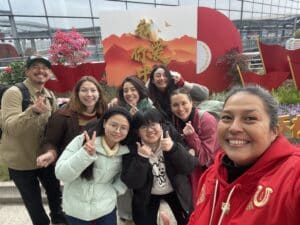
She added, “We all shared the same goal: to create opportunities our students will carry with them for the rest of their lives. This experience will stay with me forever.”
Daniela Torres, a teacher at High Tech Middle Mesa, described her biggest takeaway as both personal and professional.
“The dedication of the Chinese educators to implementing interdisciplinary PBL was inspiring,” Torres said. “They were willing to learn a structure that felt foreign to better prepare students for life beyond the classroom. It reminded me that even with different educational systems, we all share the same goal: doing what’s best for students.”
She summed up the experience this way: “An experience full of gratitude, learning, courage, and student‑centered practices that transcended borders, languages, and cultures.”
Throughout the two weeks, HTH teachers modeled the same habits they cultivate in their students: curiosity, collaboration, critique, reflection, and revision. They observed, explored, co‑designed, facilitated, and coached—embracing their role as learners as much as leaders.
As Dr. Cornejo‑Sanchez noted, the exchange reflected the power of collaboration across institutions and cultures. At its heart, the Shanghai experience was a case study of High Tech High’s belief that powerful learning happens when students and teachers are trusted as designers of their own learning.
And in classrooms thousands of miles apart, that belief came to life.